What you see from the doorways
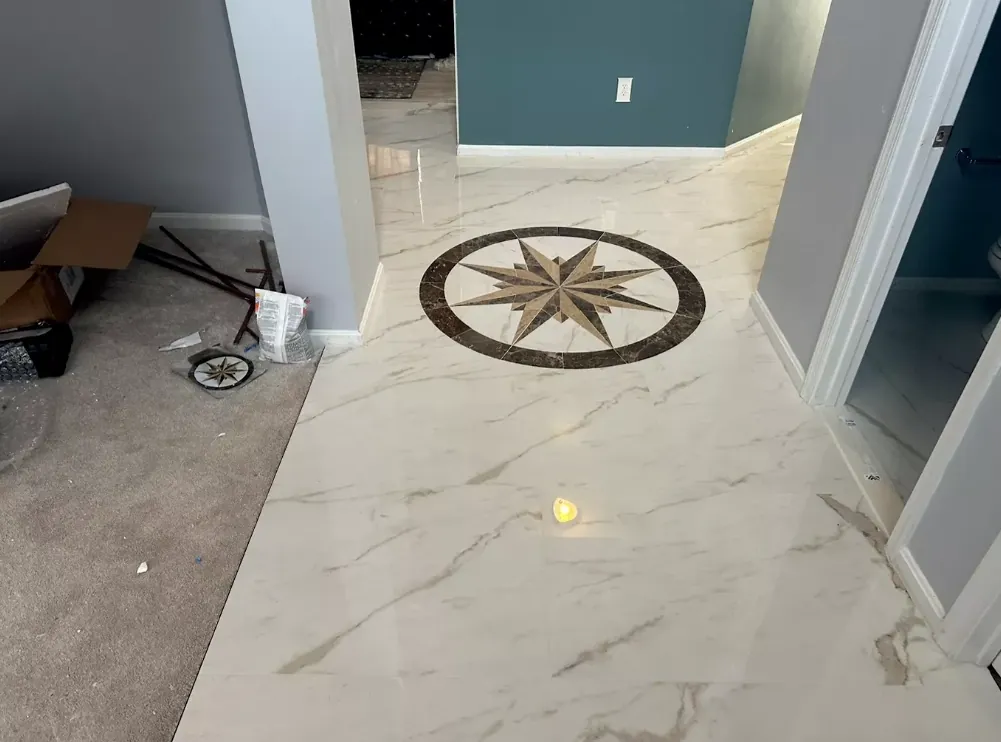
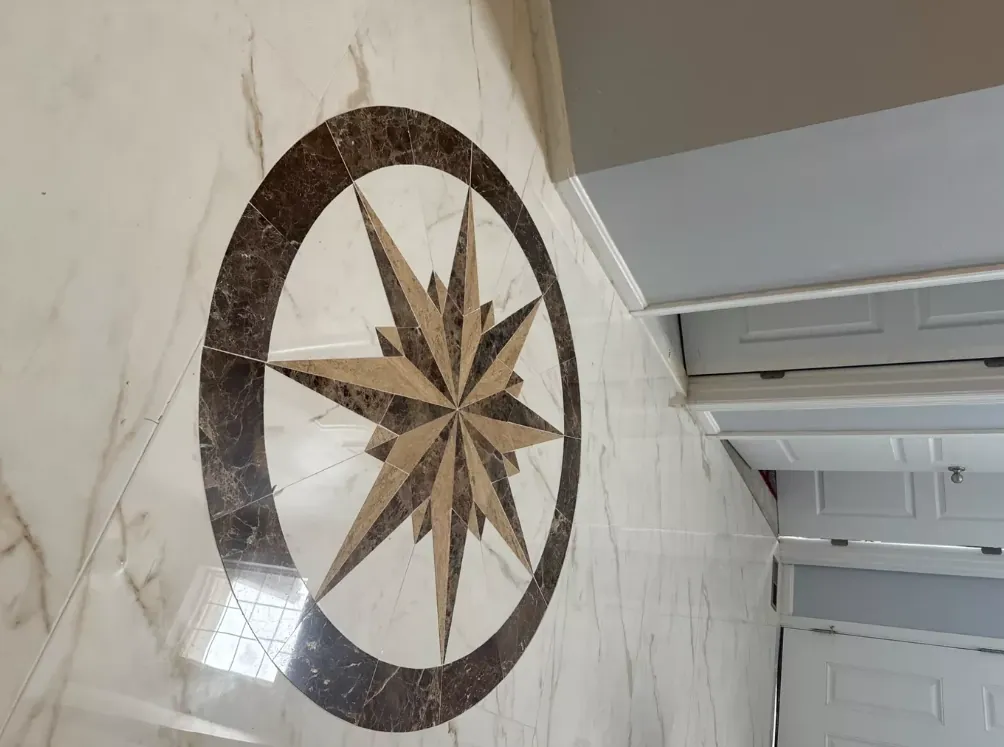
Step into this hallway from any of the doorways around it and the first thing in view is the medallion: a compass rose, a many-pointed star in tan and dark brown inside a dark brown ring, set into polished cream marble-look tile with soft gold veining. It sits in the open area where a hallway and several doorways meet, a natural spot for a pattern that is walked past and seen from more than one direction.
That is also why its position was the first decision on this floor. The medallion has to look centered from each doorway, and the field around it has to land with sensible cuts against the walls and door frames. When those two aims pull against each other, something gives: the medallion drifts off center, or slivers appear at the edges. Planning the grid outward from the medallion, then checking the cuts at each door frame before anything is set, is how both come out right.
Fitting the ring into the field
Medallions like this one usually arrive pre-assembled, so most of the work is in setting one into the field. The surrounding tiles are cut to the curve of the ring, and the close-up photo shows those cuts: the field tile meets the outer ring with an even, narrow joint all the way around. A wobble in that curve, or a gap that widens on one side, is easy to spot on a polished floor.
Medallions and the tile around them are often slightly different thicknesses. Matching their faces means adjusting the mortar bed under one or the other, then checking with a straightedge across the joint before it sets. A medallion that sits a fraction proud of the field becomes a trip edge and wears faster than the tile around it.
The field tile itself is large, with joints that run cleanly up to the ring. It continues through the doorway on the right into the adjoining room, and on the left it stops in a straight line where the next room is carpeted. A small sample of a similar medallion rests on that carpet, and painted baseboard finishes the walls.